
Pike County VINELink Coverage
Georgia offers VINE service across the state. Commission on Family Violence materials describe custody lookups, booking data, court cases, protective orders, and notifications. The official state entry point is VINELink Georgia. Statewide reach, though, is not a local promise. Nothing shows that every Pike County Jail booking reaches the service or stays current.
The Pike County Sheriff's official page posts no VINE link. Try the live search anyway. Pick Georgia, then look for an available Pike service. A hit reflects data a participating agency sent to VINE. If Pike is absent or no one matches, call Pike County Jail at 770-567-8431. An empty answer is not proof that no arrest happened.
The Georgia VINELink landing screen shows the state entry point. That is what a visitor sees before any person search.
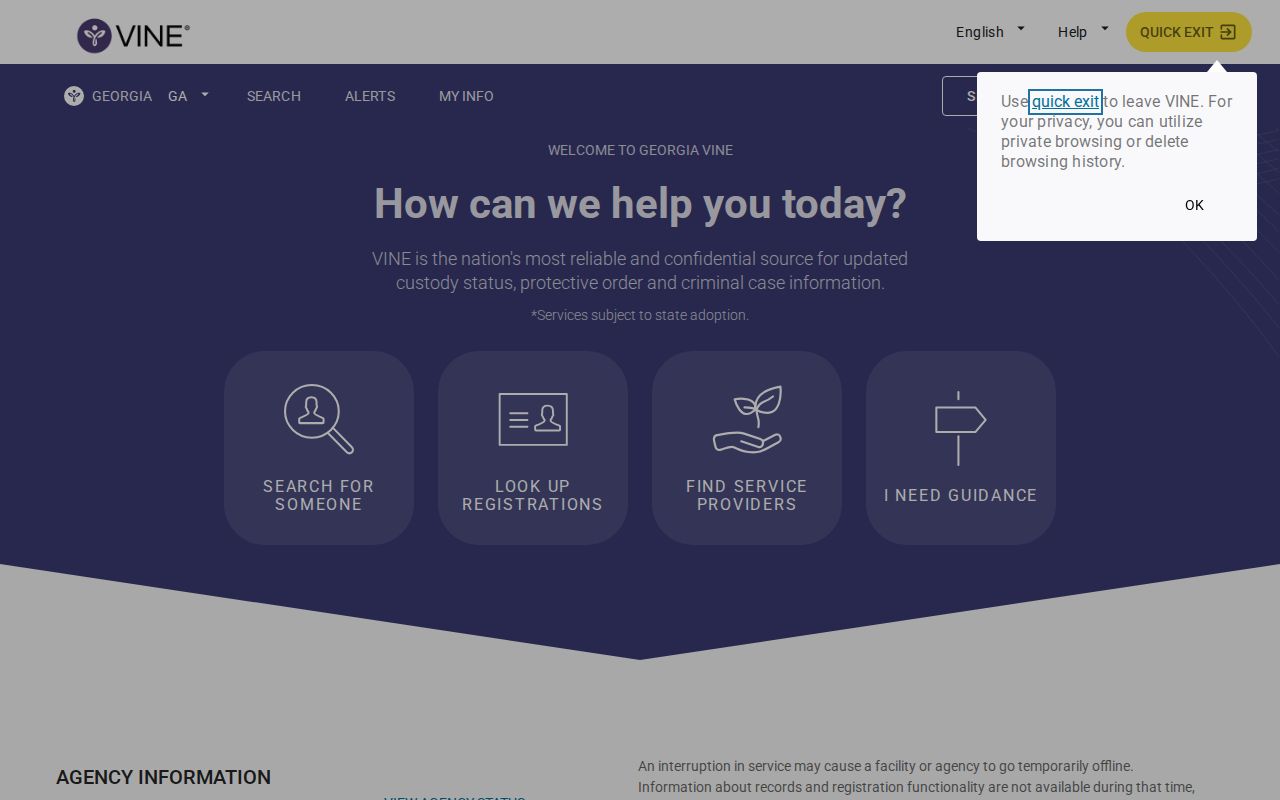
Starting at the state page keeps the search inside Georgia's service. It also stops you from mixing up Pike County with a county of the same name elsewhere.
Pike Sheriff App Is Different
The Pike County Sheriff's Office app is an official local channel. Its store description covers crime reporting, events, interactive tools, and safety news. It promises no jail roster. No booking feed or release alerts either. User reviews cannot confirm that a custody tool is current.
The sheriff's Facebook account is likewise a news outlet, not a custody database. Neither one replaces a VINELink search or a call to Pike County Jail. Keep the systems straight. The app and social feeds spread local information. VINELink handles custody searches and alert registration. It works through participating agencies.
Check a Pike Arrest on VINELink
The Georgia person search accepts a name or an offender identifier. Use details from a lawful source. Broad, name-only results can describe different people, so compare facility, county, and status before calling a record a match.
- Open Georgia VINELink and choose the person search.
- Select the available Pike service if it is listed.
- Enter the name or known offender or defendant identifier.
- Review all possible matches and compare facility, county, and status.
- Open only the matching record and note its reported update context.
- Call Pike County Jail if no reliable match appears.
A VINE record is a custody entry. It is not a full booking file. The arresting agency's report, every charge, a booking photograph, and the final court outcome may all be missing. Ask the jail or the clerk for those records.
The Georgia VINELink search form presents a blank search state with no gallery of people.

The form is only a starting point. Identity still calls for careful comparison and official Pike County confirmation.
Pike VINELink Result Fields
What you see depends on the agency feed. State materials describe the functions below, but Pike's county page promises no specific field. Treat each result as reported custody data, not a full case history.
| Possible result item | How to use it |
|---|---|
| Name or identifier | Compare with known facts; a name alone is not identity proof |
| County or facility | Confirm the record belongs to Pike or the later receiving agency |
| Custody status | Read as the agency-supplied state at the update time |
| Transfer or release event | Use as an alert, then verify with the named agency |
| Notification option | Register contact methods on the matched record |
| Booking photo | Not guaranteed and not the purpose of VINE |
| Court disposition | Not established by a custody result; check the Pike Clerk |
Custody terms carry real meaning. Just booked means the process has started and data may still be pending. In custody means an agency reports the person held. Released means local custody ended, not that a charge went away. Transferred means another facility may hold the person now. A state-sentenced person can later appear through the Georgia Department of Corrections.
Register for Pike Custody Alerts
Pick the right person first. Registration opens only after that step. Current VINE materials describe phone, text, email, TTY, and in-app notifications, and you can list more than one contact method. Phone registration uses a four-digit PIN, so store it safely; entering it acknowledges a notification call.
- Open the matching person record and choose registration or notifications.
- Select phone, text, email, TTY, in-app notice, or more than one method.
- Enter the contact details and complete the verification prompts.
- Create and retain the four-digit PIN for phone alerts.
- Review the selected events, such as release, transfer, or custody change.
- Update the registration if a phone number or email address changes.
Calls can come at any hour. An unanswered one may keep trying for at least 24 hours. It also stops once the PIN is entered. VINE is free and confidential, but it should not carry a whole safety plan alone. An urgent threat belongs with 911 or the right law-enforcement agency.
Georgia VINE Expansion and Pike
The 2024 statewide expansion matters. It created an online Georgia layer beyond any county's own website. The Georgia VINE training description covers booking-data searches, custody status, case status, protective orders, notifications, accounts, and service-provider resources. That is solid proof Georgia deploys VINE.
It settles nothing about Pike. Two questions stay open. Is Pike County Jail feeding a particular record? How fresh is that record? Test both live, every time. A statewide announcement is not a promise about each local booking.
The Georgia VINE education page supplies official context for the search and notification functions.
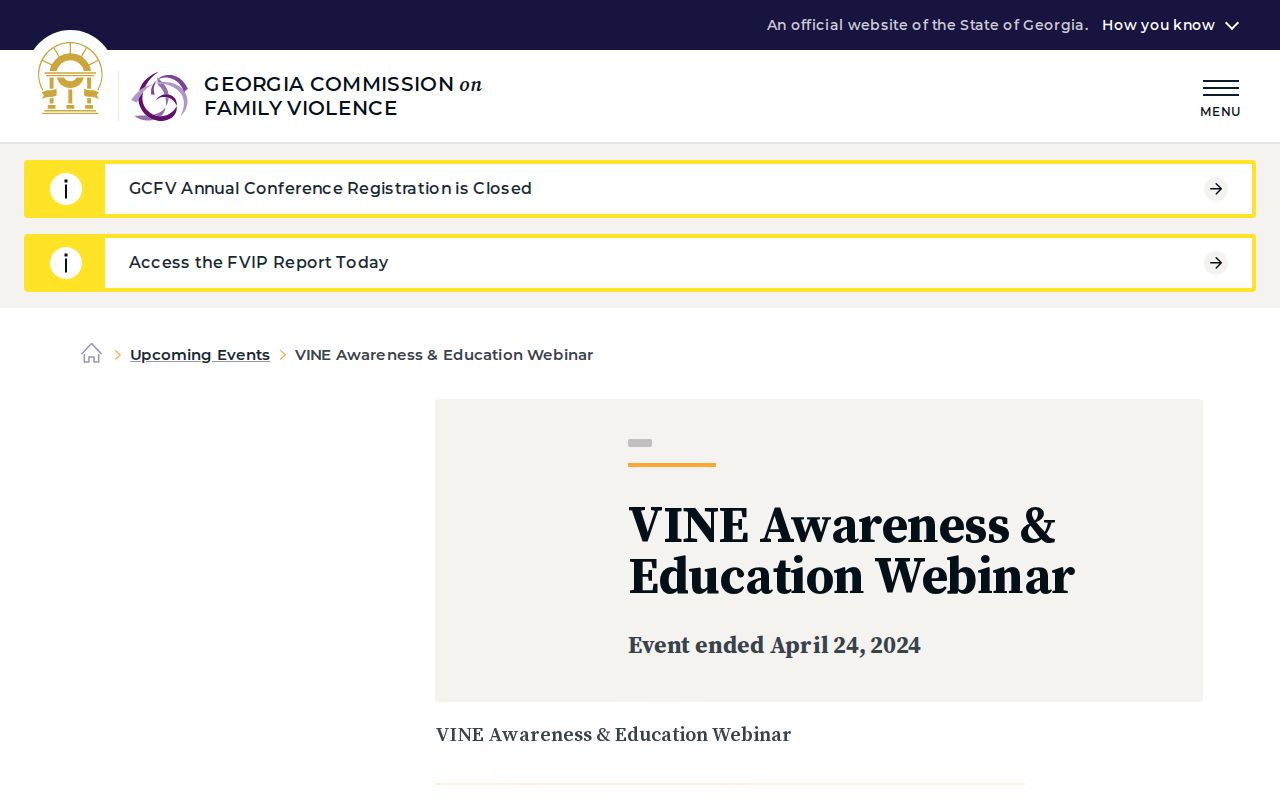
The state training backs up the service description. Pike custody facts still need a live result or a call to the jail.
Pike VINELink Limits and Verification
VINELink has real gaps. A brand-new Pike booking may not show up yet, and a jail that skips the VINE feed stays invisible until you check locally. The system also answers one narrow question: who is in custody right now. It carries no booking photos, no incident reports, and no court docket. Pike's sheriff page posts no public roster, so the jail phone line is still the fastest local check for a recent arrest.
Federal custody runs on entirely separate systems. For federal inmates, the Bureau of Prisons locator covers its own population, while ICE runs a detainee locator of its own. Marshals prisoners get scattered across state, local, and private facilities. A blank VINELink result tells you nothing about those systems. The Georgia Department of Corrections offender query picks up only after state intake, so it will not catch every recent Pike arrest either.
For a booking too fresh for VINE, the Pike County 24 Hour Arrests path walks through confirmation step by step. The Pike County recent arrests hub sorts out the jail, booking-record, court, and state-custody channels separately.
Pike Arrest Records and Innocence
Custody status answers one narrow question: where a person is held right now, or whether an agency has flagged a change. It is not the whole story of a Pike County case. A booking charge can shrink, shift, or vanish once prosecutors and judges get involved. What starts as an arrest count at intake rarely matches the final court file word for word. For that reason, any Pike County arrest inquiry should end at the courthouse docket. The Pike County Clerk criminal division posts the filings, warrants, pleadings, and appeals that trace a charge from start to finish. Match the case identity with care, since disposition is its own animal, separate from a release or a transfer between jails.
When Pike VINELink Finds No Match
A no-match result has several common causes. The Pike booking may be too fresh for the feed. The local record may never reach VINE at all. The name might be stored differently than you typed it. Or the person could sit in another county, in Georgia corrections, or in federal hands.
Repeating the same broad search fixes none of that. Call Pike County Jail instead. Give the full name and the approximate arrest date, then ask whether the person was accepted, is still held, was released, or was transferred. Another agency's arrest means requesting its incident or arrest record separately. If Pike took the person in, a focused Open Records request can seek the booking number, intake time, release event, and other releasable fields. Photo release follows its own rules and is never guaranteed.
State prison custody changes the picture. After state intake, the person becomes searchable through GDC. Federal custody requires the matching federal locator. Keep these paths separate rather than blending them into one status.
Responding to Pike Custody Alerts
Read before reacting. When an alert arrives, check the event type and the agency name first. A transfer alert points to a different facility. A release alert closes the listed custody episode. Neither tells you the charge was dropped. Timing can matter for travel, court dates, or safety. Confirm the change directly with the named agency.
Keep the phone PIN and contact methods current. An alert that looks wrong? Compare the identifier and facility against your original registration. Two people can share a name, so never assume they are one person. VINE supports awareness. The jail and the court keep the official record of custody and case outcome.
If alerts stop coming, reopen the matched record and review your saved methods. A transfer can also hand confirmation duties to a new agency.
Write down the event type and time. Treat the alert as a pointer, not a file. A release notice says nothing about bond terms, supervision, or the court schedule. A transfer notice does not explain the receiving system's rules. Let the alert identify the right office, then verify the status there.
Privacy depends on correct contact details too. Use an email or phone the registrant controls, and update them after any change. The state and vendor materials call registration confidential. Yet ordinary care still helps. Messages can surface on a shared device.
Public Record Search
Sponsored Results